It's a Love Thing
06 Jun 2019
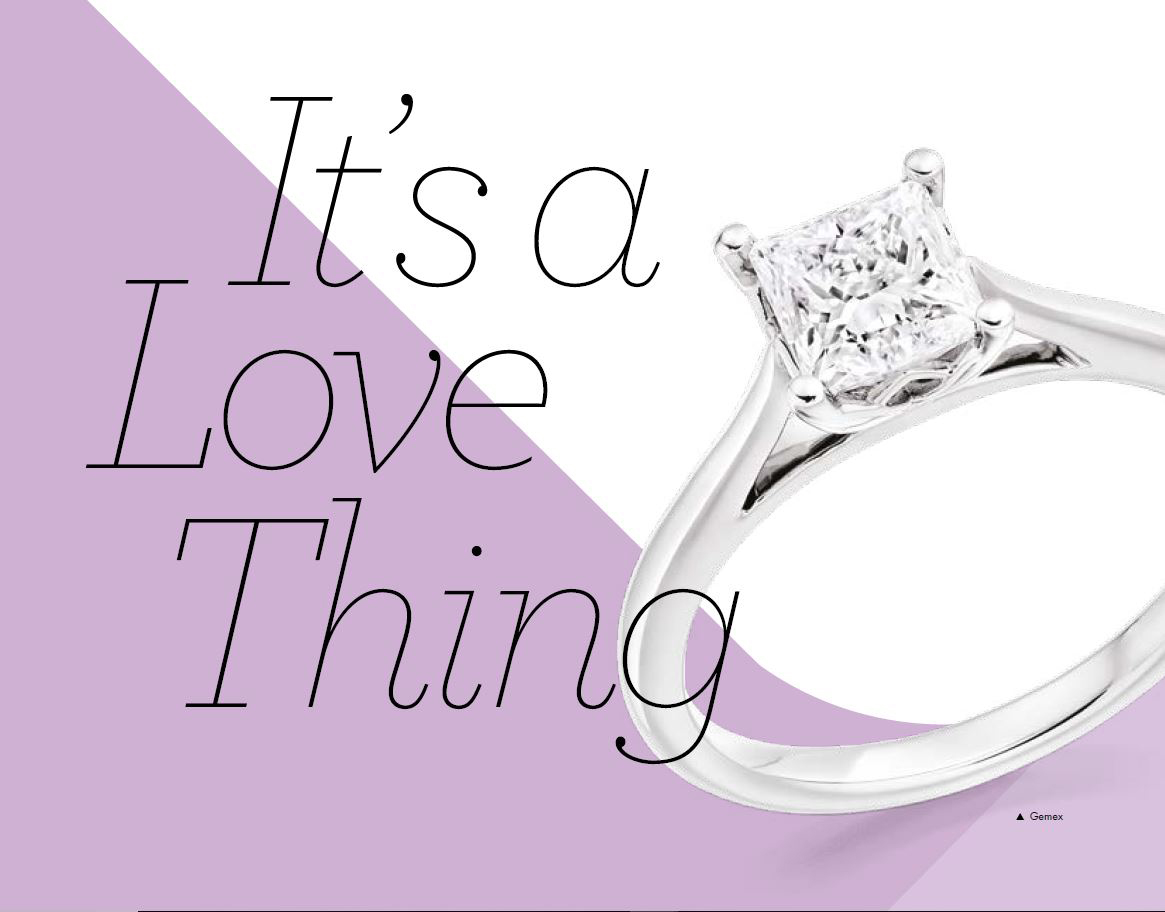
While fewer of us are getting married today, it doesn’t necessarily follow that we’ve lost our desire to cement meaningful relationships with beautiful jewellery, says Belinda Morris.
Let’s ignore negative statistics and focus instead on the very many reasons to invest in diamonds – engagement, betrothal, wedding, commitment, new baby, friendship, self-indulgence… Think laterally.
Looking at the positive factors currently influencing the diamond jewellery market, two recent royal weddings have done no harm. Trilogies and cluster/halo styles
are nothing new of course, and both enjoy strong sales. Not as strong as brilliant solitaires obviously…
Aesthetics
“While the brilliant cut is still champ, we’ve seen movement in oval and princess shapes,” says designer Andrew Geoghegan. “And yes, solitaires are the strongest for engagement rings, but more specifically solitaires with accent stones – halo or shoulder set.” Hatton Garden-based Olivia Grace finds that the cushion cut is the most popular shape among clients who want an Art Deco or other vintage look. And while trilogies were popular immediately after Meghan’s engagement, the halo remains the most requested style.
At Brown & Newirth, brilliant solitaires reign in the Bloom collection, followed by haloes, with growing interest in oval shapes. “This is particularly the case in locations where customers are fashion-focused,” says marketing manager Jen Ashby.
“They’re still classic but they can appear larger than a brilliant due to the elongated shape, so offer value for money for customers concerned about carat weight.”
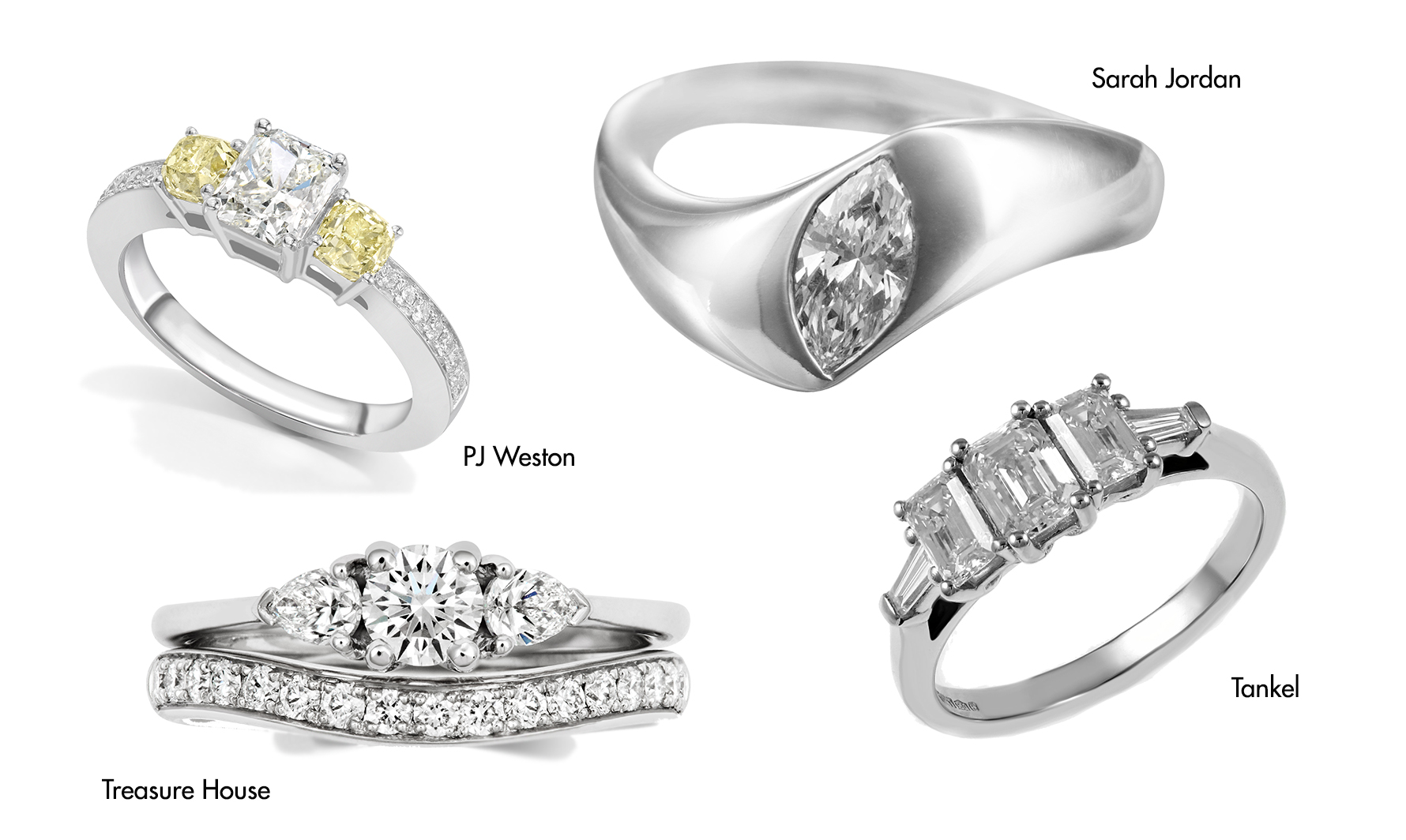
At Hockley Mint popular stones are trending towards softer, more curved shapes, with ovals and cushions catching up with rounds. Bespoke trilogy rings often feature emerald cut centre stones with baguette or trapezoid outer diamonds for an Art Deco feel.
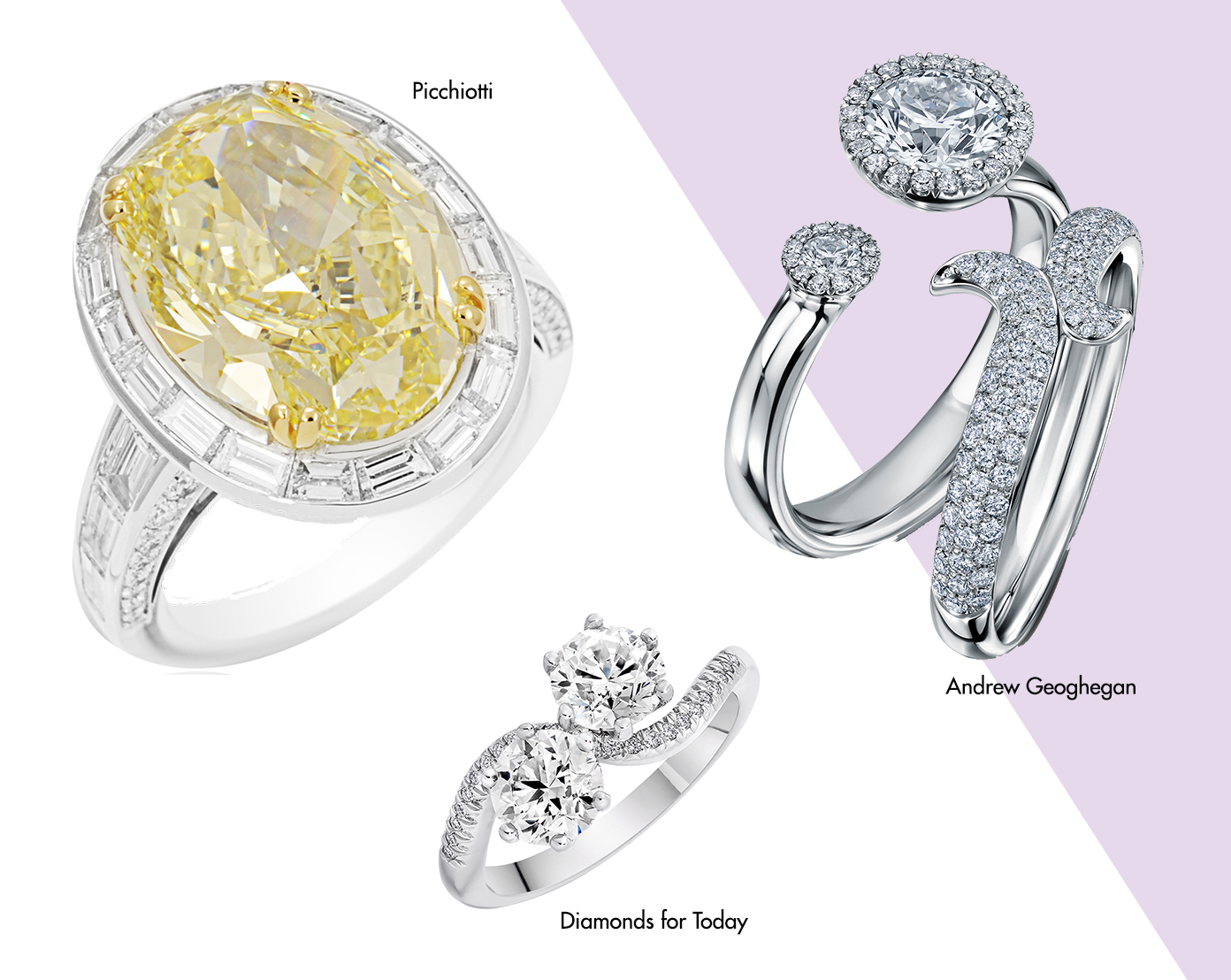
David Fell of Hans D Krieger reports that pear shapes have been strong over the past 12 months and Phil Spencer of Diamond DE says that trilogy rings are his most requested engagement rings (often with a coloured central gemstone flanked by two diamonds) and oval, round and emerald are by far the most popular shapes.
Andy Bass at Diamonds for Today adds that there’s a trend for fancy cuts. “But well-established cuts set into interesting shapes – like Vs, twists and asymmetrics – are also making an impact,” he adds. “Princess, oval and pears are particularly popular, but there’s a lot of interest in shaped rings created using invisible setting of traditional stones. And as couples spend so much more on their wedding now, the spectacular bespoke ring is certainly a growing trend.”
What’s clear is that you have to keep moving to ensure success – no relying on the same old same old. “I’m seeing more and more designers/brands creating simpler, more minimal designs of late and with more interesting cuts – and we’re looking into this also,” says Geoghegan. “With so much diamond product out there, the key for us to is create innovative, unique designs that not only present the diamond beautifully, but add a further dimension of beauty.”
Le Petit Prince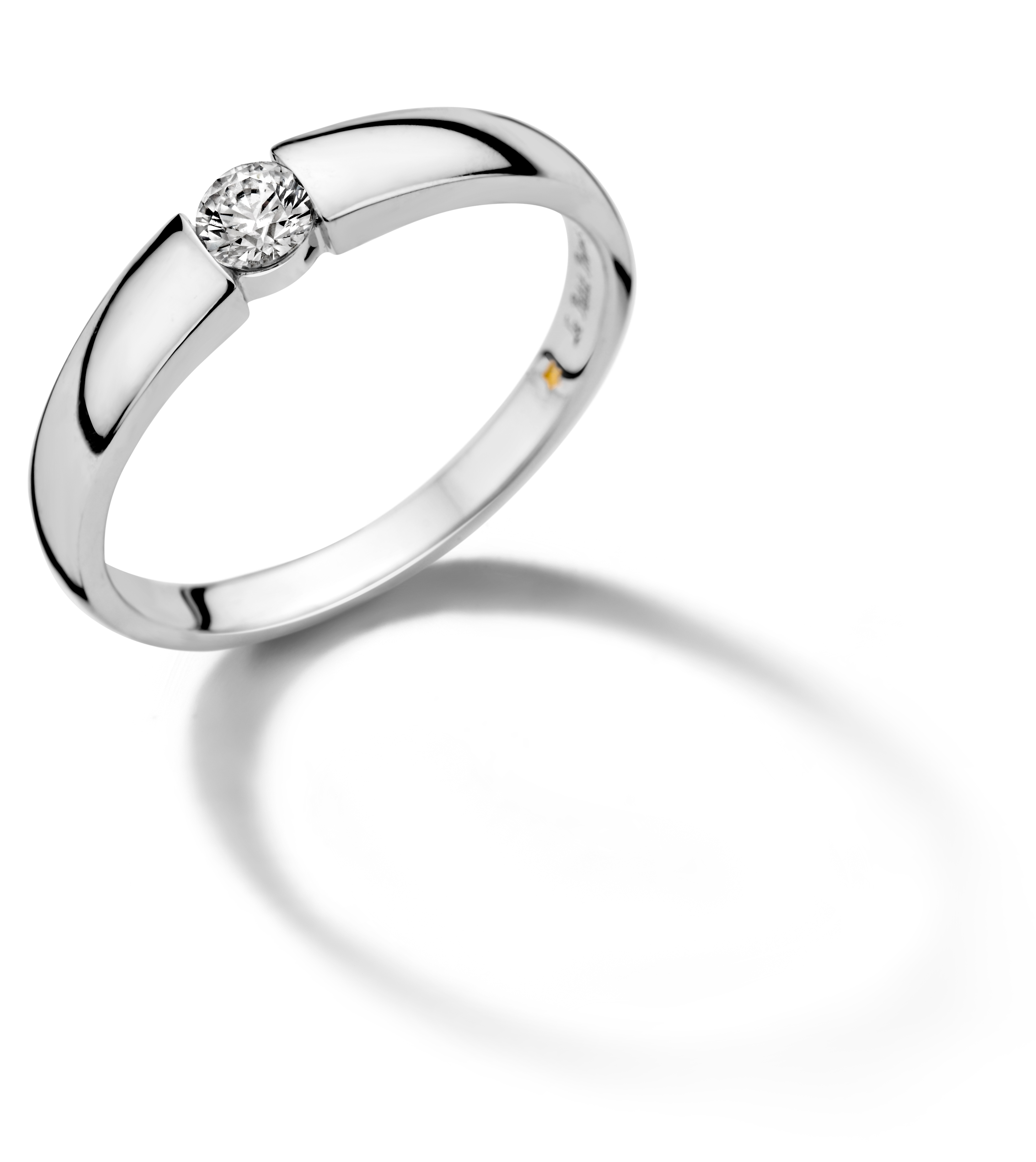
“We’re witnessing an increase in customers looking for design differentiation on engagement rings,” adds Naomi Newton-Sherlock of Domino Jewellery. “We’ve been incorporating diamond detailing on shanks, as well as creative silhouettes and different patterns to enhance the centre stone across several ranges, and we’re introducing even more designs in our new Diamond Ring Mount collection launching this summer.”
This year another avenue of business for Gemex is a pared-back ‘bread and butter’ collection of four- and six-claw solitaire designs without diamonds on the shoulders. “It’s a very competitively priced range, sold finished with certificated diamonds,” explains MD Lee Ruben, “and we plan to have a core range of 50 to 60 designs.” The majority of the brand’s rings are in platinum –specifically an alloy with five per cent cobalt – “it’s a more malleable metal, better for more intricate designs,” he explains.
Meanwhile, some are reporting yellow gold’s resurgence. “After two decades dominated by white gold or platinum set with white diamonds, our retailers are getting requests for more adventurous, bolder, colourful pieces,” says Bass. “Many of their engagement rings are being sold to customers in their 30s and 40s, who are more confident in their ring choice.” And Clogau’s Compose by Clogau® relaunched range offers a variety of individual styles – from elegant to romantic – in yellow or rose gold.
The Four Cs
Consumer confidence also comes via the internet. “Today’s consumer goes online, does their homework and self-educates before they even step foot in a store,”
says Rebecca Smith of Royal Asscher.
“When they do get in store there’s always a general story told about diamonds and there’s a simple cut story that could be communicated. Consumers know that cut is important, but perhaps many seek out carat weight without realising the blaze of light from across the room comes from a beautiful cut, not a bigger diamond. We’ve always had our cutting prowess as a central marketing message. Our cutting and finessing abilities are what saw us entrusted with some of the most important diamonds in history.”
“Order of importance tends to be the carat weight followed by colour,” agrees Ashby. “To the untrained eye these are the two features that are easiest to compare. Most consumers we encounter believe that cut refers only to the diamond shape, so we have to educate them on cut in relation to proportions. We use only cuts graded very good and excellent – we value this as much as clarity.”
“The importance of cut should be emphasised,” agrees Howard Levine of diamond trading platform Diamnet, “but the retailer needs to be able to explain it well to customers.” Poppy Elder, creative manager at Hockley Mint agrees.
“Cut is definitely the ‘C’ that’s least discussed, and it can make a huge difference to the look of a stone if it’s poorly cut – even more so than a few grades of colour or clarity. I think retailers have a responsibility to educate their staff, as well as consumers, to understand the different aspects that make up a diamond’s overall look and try to make them understand that it’s more than the main aspects on the certificate.”
Hans D Krieger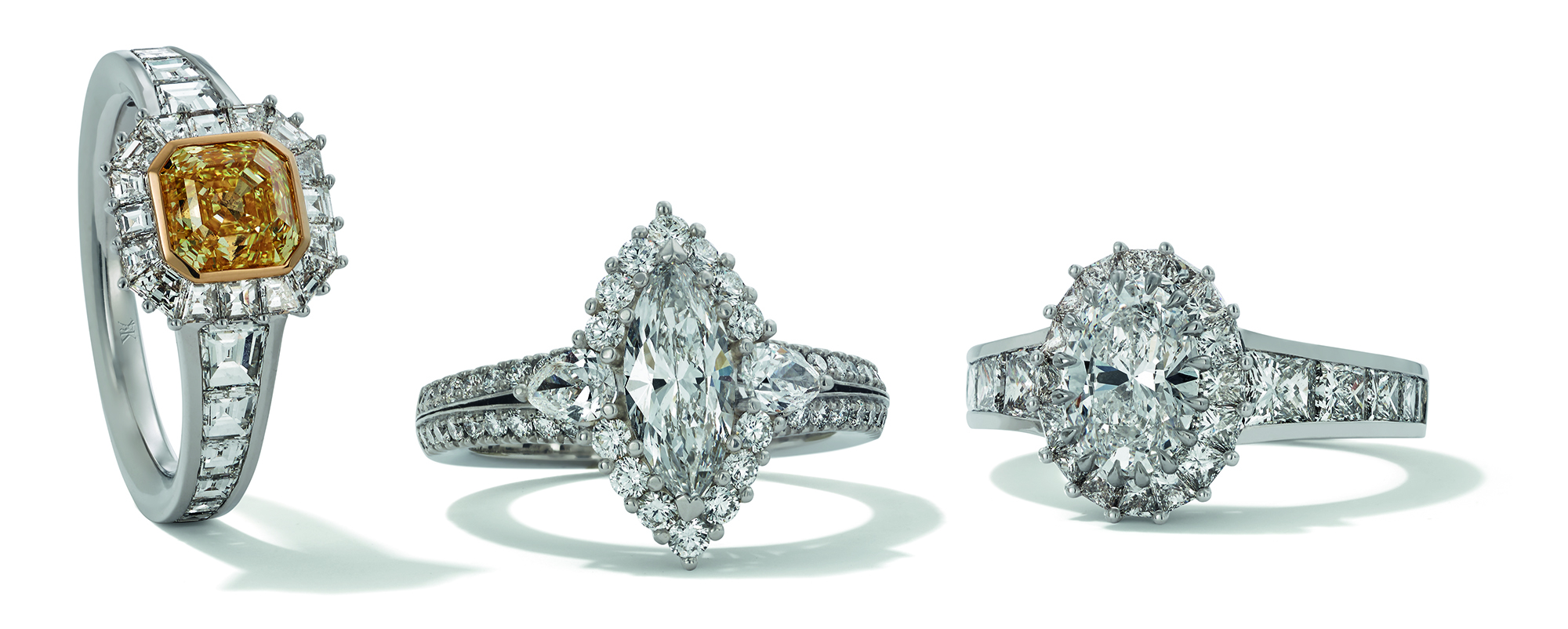
“Of the four Cs cut is the hardest to explain, so it always gets left out,” adds David Fell. “It’s also the hardest to decipher on a certificate and with the commoditisation of diamonds through the certification process, it’s easier to sell a F VS stone on a cert, rather than on another based on the beauty of the cut. However, the use of branded cuts has made the consumer more aware of the multitude of interesting shapes in the market place.”
“Clarity and looking lively are the most important and even if you have the other Cs in place, a badly-cut stone can ruin the overall aesthetic,” says Rachael McTiernan of Wedds & Co.
For Helena Lappin at Olivia Grace colour figures with clients “who’re lowering the price with a clever Si1 or VS2, where there are no [eye-visual] marks in the diamond and maybe a small feather mark on the side, which can be hidden with claws. I’ve always added a fifth ‘C’… for ‘character’”, she adds, “each diamond has its own characteristics that make it special.”
Price Points
Beauty is a given but ultimately it’s about price; even the super-rich like value for money. “We’re finding that the sweet spot is the cheaper-to-medium end – about £599 to £1,000,” says Himanshu Shah of Andre Michael. “Jewellery retailers have a fighting chance against the internet if they avoid the E-colour GIA certificate route. It’s very hard to get the business that on-line offers – a basic solitaire with a GIA cert.
Shops are reluctant to go for such thin margins. It’s up to retailers to explain to customers that they can have a one-carater that sits below the GIA offer. Most people trust their jewellers,” he adds. “I know retailers are reluctant to keep stock of anything that doesn’t sell quickly, but they need to think about who they’re fighting. And we’re pushing ‘difference’ to also help beat on-line – something with more work in it.”
Rebecca Smith sees the same issue:
“The UK jewellery market seems to have particular concern over high stock levels; the trade is talking about slow turnover of diamond-based jewellery. Embracing brands with a genuine source of differentiation is a wise move. In harder times the challenge is there to create opportunity, be productive, exciting, innovate, grow, evolve,” she says. “Royal Asscher is offering UK retailers four fancy shaped loose diamonds programme and/or bridal collections to grow their business. The beauty of [this suite] is customers come into store and explore various styles through diamonds in expressive settings, or get that perfect loose diamond and work with their jeweller to create a personalised masterpiece.”
“Price is obviously a concern… but it doesn’t tend to be a major issue with our customers,” says Poppy Elder, creative manager at Hockley Mint. “The majority have longstanding relationships with us and tend to trust that we’re competitively priced – even more so since we started to supply our mounts fully finished. They’re commenting that the price is comparative to sourcing their own stones… but without the extra hassle.”
Platforms like Diamnet can help retailers compete with on-line, as can suppliers, such as Gemex which has fine-tuned its website to provide stores with all the tools to create myriad variations to suit all requests. Wedds & Co’s new website too will give its retail customers access to all its collections, featuring live pricing for customers, and be able to personalise with their own shop.
Accessorise All Areas
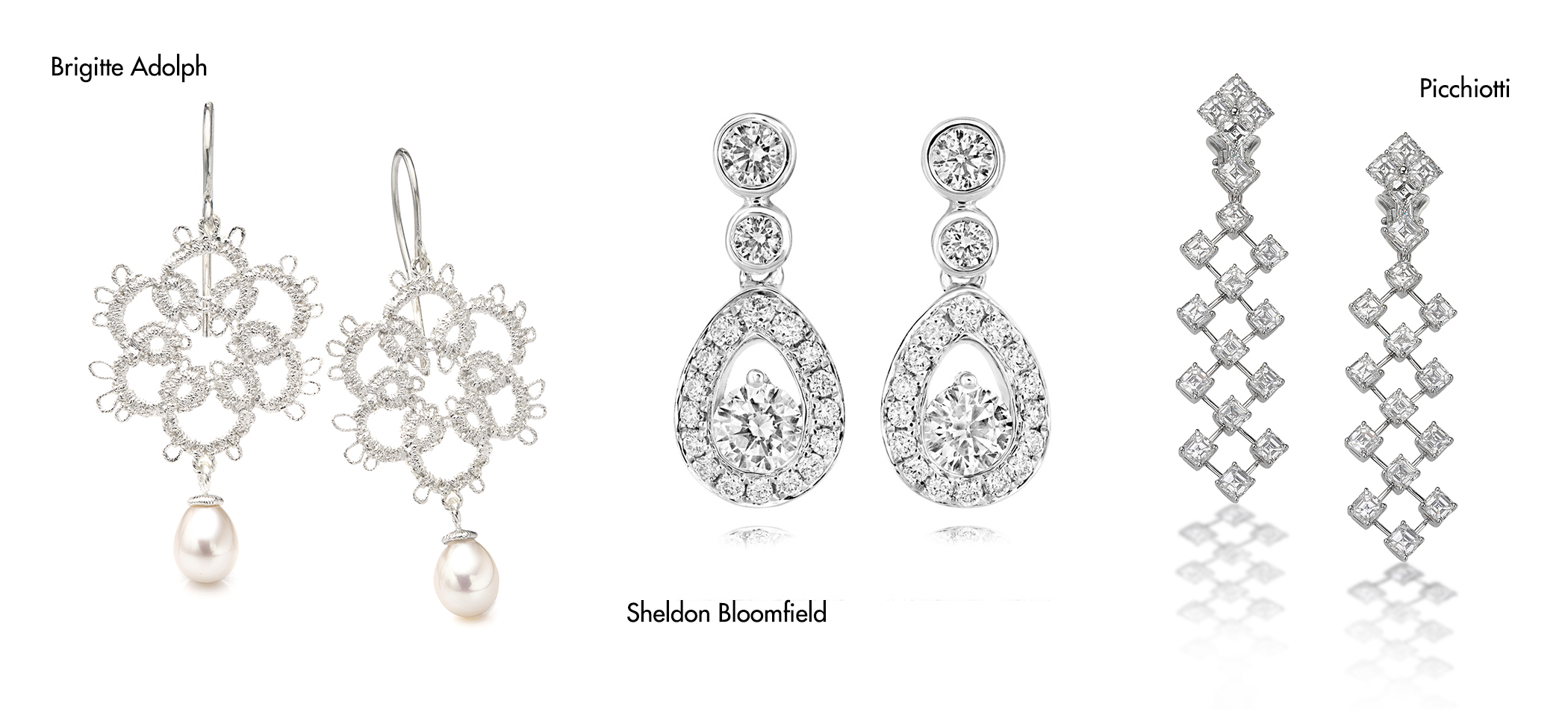
After the rings, earrings are arguably most important says Diamonds for Today, which offers brilliant cut diamond drops and classic studs (and not just for women…). The FlexiLink collection of diamond line bracelet and matching collar also offers bespoke with fancy cut and coloured diamonds. Picchiotti’s geometric drop diamond earrings would set off a simple neckline and swept-up hair-do, as would Sheldon Bloomfield’s diamond drop earrings with continuously moving drilled centre stone.
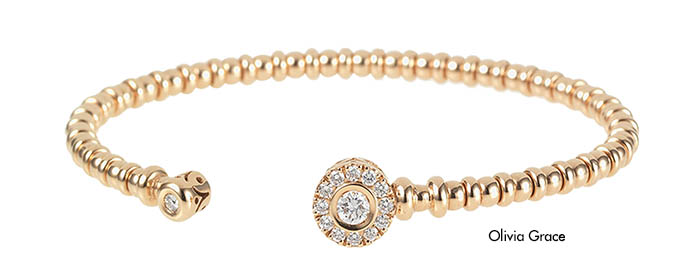
Sleeveless gowns demand cuffs, bangles or bracelets, like Garrard’s filigree style with diamonds. For the ultimate in ethereal delicacy there’s the signature lace-effect in white gold or silver by Brigitte Adolph – a collection of rings, bracelets and earrings and pendants, often featuring the bride’s alternative gem, a pearl… but that’s another story.
Testing Times
Not so long ago questions about synthetic diamonds potententially creeping into the chain, were met with the word ‘trust’… conversation closed. No longer. “For sure it’s an issue,” says Treasure House's Danny Cohen. “We’re affected and so the retailers are affected; lab-grown is getting into melee. We’ve ordered a machine to check the diamonds in our jewellery so we can state it on our invoices.” Hockley Mint is also taking precautions – the challenge of lab-grown diamonds entering the supply chain and mixed with natural diamonds has led to the investment in its own diamond tester.
As well as asking about opportunities to include lab-gown diamonds into its designs, Domino’s retailers are also asking about controls and measures in place. “We have the ability to test diamonds with our new DeBeers SYNTHDetect machine, so can advise whether the stones are natural or lab-grown,” says Newton-Sherlock. “[It] allows us to test loose and mounted colourless stones with no lower size limit.”
“Customers are definitely asking about this, but there’s no chance of selling a lab-grown loose diamond as all our diamonds are over 18pt and certificated by GIA, IGI or HRD and I have controls in place for melee,” says Gemex’s Ruben. “We insist that all made-up goods are subject to random testing and the wording [on documents] from our suppliers state that the diamonds are not lab-grown.”
Andre Michael asks its RJC-compliant suppliers to screen for lab-grown stones, but also has its jewellery independently screened. “Retailers are asking for this,” says Shah, “and this allows them to give an independent report to reassure their customers. However, the real problems will come later, when lab-grown diamonds hit the secondary market. There’s no intrinsic value in synthetics.”
Responsible Sourcing
The biggest single change recently is the increased interest in responsibly sourced gemstones, especially among millennials,” says Spencer. “We pride ourselves in tracing our gemstones back to their mine of origin; we’re confident of the quality and ethics of our end product.”
Elder agrees:
“We’re seeing more customers concerned about stone origin, as consumers are becoming more aware of the possible ethical implications of goods they purchase. Although the diamonds we supply come from reputable sources who follow the Kimberly Process etc, we go a step further by offering Canadian Arctic Circle diamonds for those wanting to know the exact source.”
Lappin’s clients also want ethically-sourced diamonds. “They want to know where they’re from, how they’re mined and who cuts and polishes them. They want a guilt-free purchase,” she says. “I buy alluvial diamonds from Namibia and polished diamonds from a Responsible Jewellery Council-accredited manufacturer.”
An original UK member of the RJC, Domino has always been vocal about responsible sourcing. “Our customers can be confident in our calibre when it comes to ethics and transparent supply chains,” says Newton-Sherlock. “RJC accreditation is one of the metrics we use to measure success within the Quality Division… [as is] membership of Fairtrade.” New Austrian brand, Le Petit Prince by FJF Jewellery is also an RJC member with all diamonds and components of its engagement rings ethically sourced.
Consumer concern isn’t a given though.
“These issues are debated endlessly in the trade, but most consumers don’t want to discuss potential problems,” argues Bass.
“As with synthetics, engaged couples rarely ask questions that might result in a negative answer! They just want a diamond ring and to be happy!”
Bridal Jewellery News
Monomer wedding rings now in UK
Monomer, designed by former-architect Thomas Mrokon, combines aesthetics with comfort, with a play on contrasts – such as straight lines with curved. The two connected halves of the Aion wedding ring line fit together to form one unit – the symbolism of two halves no accident. Available in 14/18ct white, yellow or rose gold or platinum and can be customised with exposed or hidden words or stone. Contact: jan@deutschecraft.com
Monomer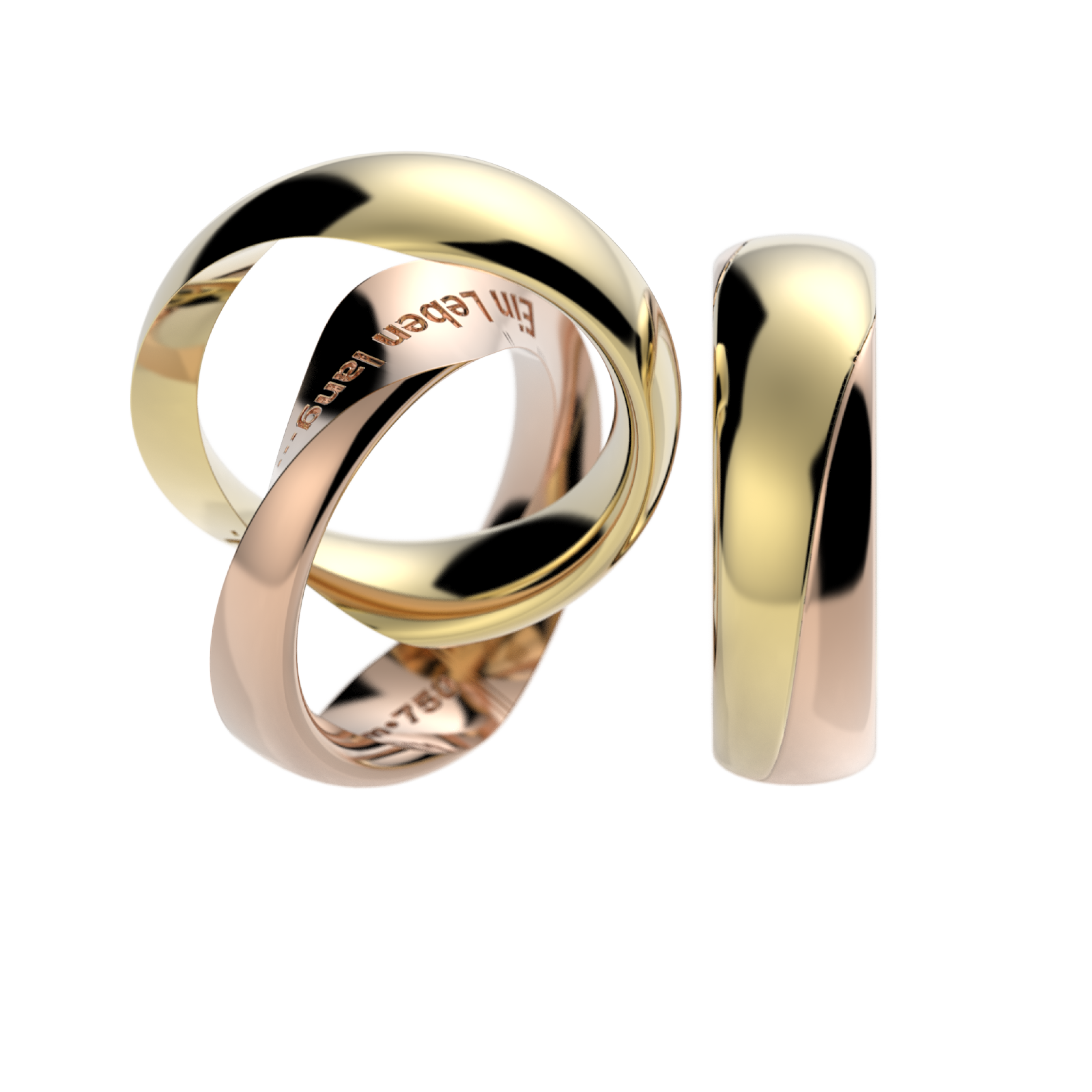
Fei Liu bridal collection
Fei Liu Fine Jewellery has relaunched its bridal range, offering award-winning designs with a number of options to the customer: platinum, 18ct white, yellow or rose gold; mounts for a selection of the designs available with or without diamonds, in three sizes: 0.15ct, 0.25ct and 0.5ct. The rings come in a luxurious display box, featuring the Aurora, Arabella, Amara and Lily of the Valley collections, plus a new design. All engagement rings have been designed to harmonise with a wedfit wedding ring.
Fei Liu 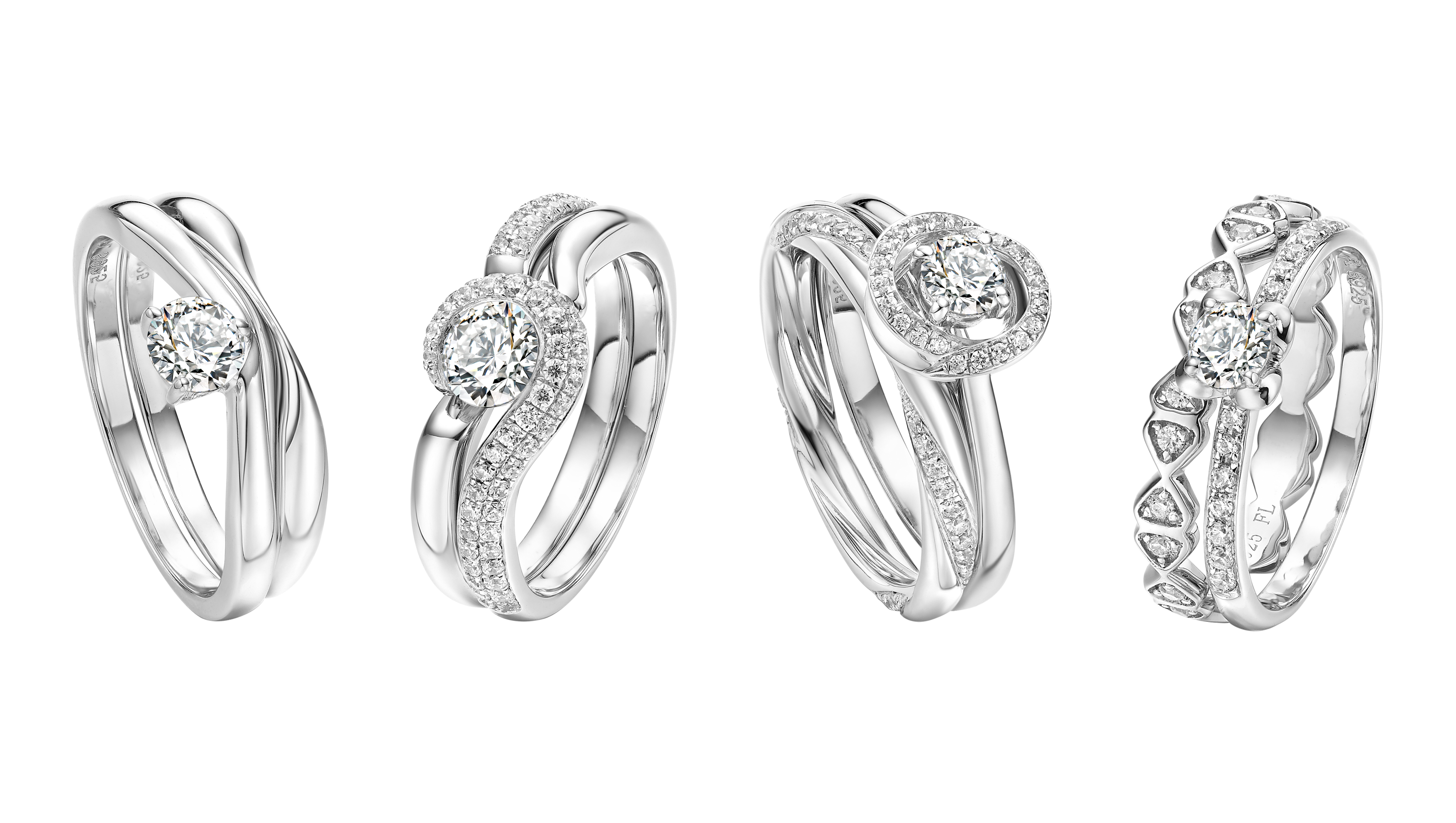
Arabel Lebrusan introduces vintage rings
Ethical jeweller Arabel Lebrusan and jewellery journalist Claire Roberts have launched the on-line Vintage Ring Company – affordable vintage and vintage-style engagement rings, featuring a diverse collection of curated pieces, priced under £2,000. Each ring comes with a Certificate of Authenticity, issued and signed by The Goldsmiths’ Company. The offer comprises: Antique Engagement Rings (pre-1940s), Vintage Engagement Rings (1940s-1970s) and Vintage-Style Engagement Rings (post-1980s) – mid-Century classics alongside Edwardian, Victorian and Art Deco designs.
Another Diamond... another setting
An innovative setting has been invented by new Japanese company Another Diamond, together with diamond tool manufacturer, Kitagawa Diamond Industrial. The world’s first single-point diamond setting on a gold or platinum ring sees diamonds not needing to be claw-set. The diamond can be seen from every angle – with no restrictions on varieties of diamond shapes new jewellery designs are possible. The contemporary lines of Another Diamond’s brushed white and yellow gold pieces – now being marketed in the UK – honour the natural diamonds’ characteristics, the polish retaining the original rough shape. Each piece is one of a kind. anotherdiamond.jp
Another Diamond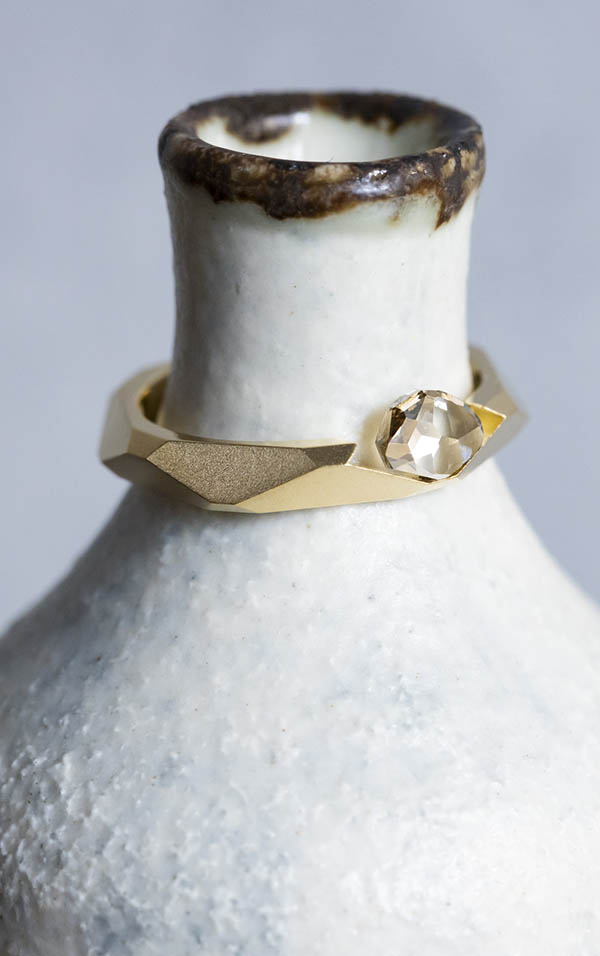
Download Feature