The NAJ Celebrates International Women's Day 2025
04 Mar 2025
The theme of 2025’s International Women’s Day is #AccelerateAction.
According to data from the World Economic Forum, at the current rate of progress, it will take until 2158 – which is roughly five generations from now – to reach full gender parity. Focusing on the need to ‘Accelerate Action’ emphasises the importance of taking swift and decisive steps to achieve gender equality. It calls for increased momentum and urgency in addressing the systemic barriers and biases that women face, both in personal and professional spheres.
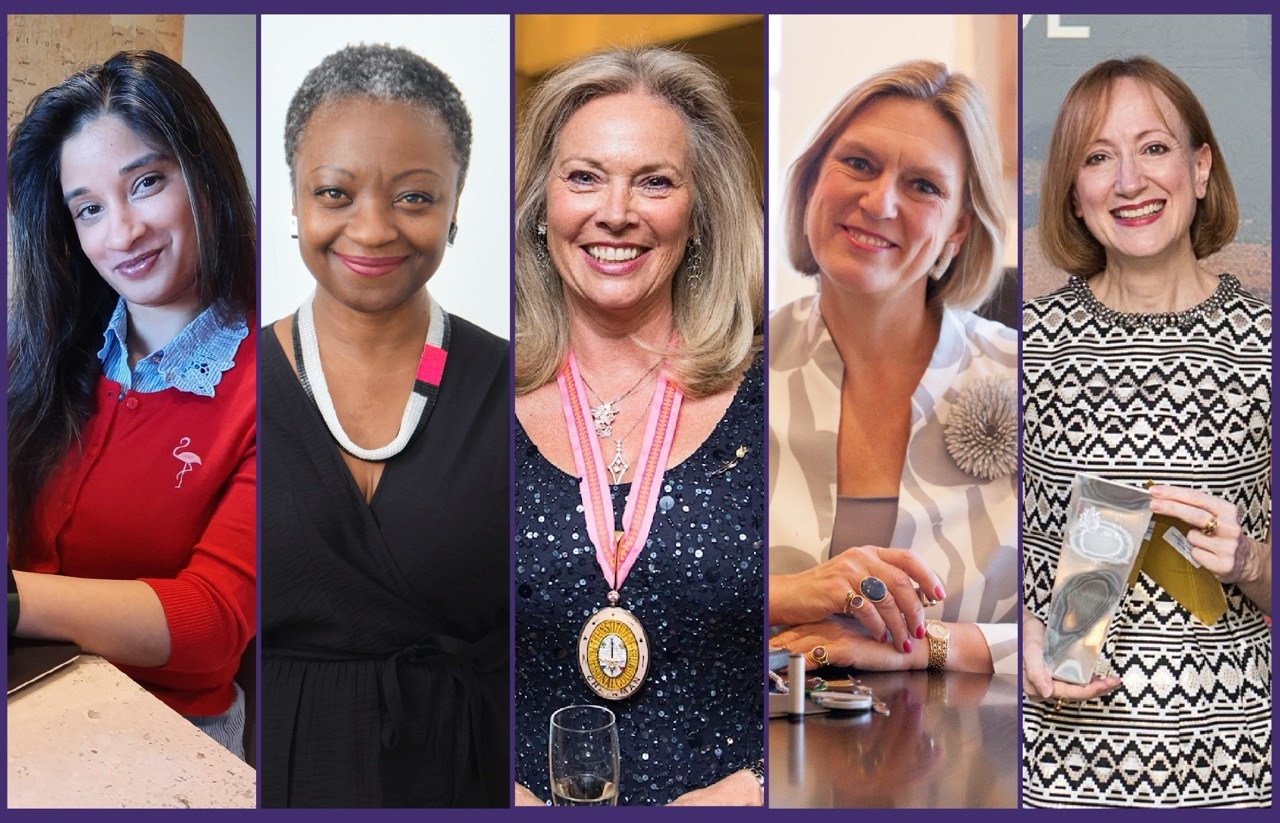
Here at the NAJ we want to mark International Women’s Day, and this important campaign, by celebrating the achievements of some of the many influential and successful females in our industry, who talk about their jewellery journeys, female empowerment and gender equality.
POOJA SAHNY, SIERRA CONSULTANCY FOUNDER
Describe your jewellery journey
I studied silversmithing and goldsmithing in Antwerp, Belgium and honed my skills, learning to solder, polish, and understand metal weights through wax carving. I entered several competitions, becoming a finalist twice, boosting my confidence significantly. My work has also been exhibited multiple times at the Diamond Museum in Antwerp (DIVA).
I initially struggled to communicate my designs through traditional sketching. When I was studying, CAD courses weren’t as accessible as they are today. I resisted using CAD for as long as possible, believing it was too technical and feeling intimidated by computers. Eventually, I gave in and enrolled in GIA London’s CAD course. That decision changed everything – CAD opened my eyes to new possibilities.
I later worked as a designer for a diamond jewellery firm for several years, where I explored various software packages. After a thorough evaluation, we chose 3DESIGN as the best fit for our needs.
A few years later, an exciting opportunity arose in the UK to work with Gravograph, now part of the Gravotech Group under Brady Corporation. For seven years, I represented their software side, Type3, the developers of 3DESIGN, in the UK before branching out on my own to provide software, training, support and consultancy.
Now, six years later, I share my experience with jewellers who may be hesitant about CAD. While it’s not for everyone, finding the right software can remove many of the limitations that come with working solely at the bench.
Would you say that being a woman has impacted your career?
I believe this has helped me stand out. The majority of jewellery software representatives are male, and it's rare to see a woman involved in sales, support and training. Among the worldwide 3DESIGN representatives who provide all these services, I believe there are only a handful of us. It appears that more women are part of the sales force rather than the technical side of the industry. This is also noticeable at trade shows.
Do you think women have had to work harder to be more 'visible'?
There are definitely times when this is true. I believe women often feel they aren’t taken as seriously as men in the same roles. I’ll admit, I’ve felt this way myself. Women are frequently underestimated or hesitant to speak up, especially if they choose to have a child. The assumption is that after giving birth, they won’t return to the workforce or continue pursuing their careers. It’s such an outdated, generational mindset. Why can’t a woman be a mother and build a career at the same time?
Does the jewellery sector actually offer workplaces where women can thrive?
Opportunities exist everywhere, but women need the drive and confidence to pursue them. I emphasise confidence because I often meet incredibly talented women who hesitate or doubt themselves.
Additionally, many companies prioritise hiring experienced candidates, making it challenging to get a foot in the door. This is where determination truly matters – how badly do you want it? For every available position, there are often 10 times the number of applicants. To stand out and succeed, you need to be strong, self-assured and able to think creatively or adapt quickly. The opportunities are there for everyone, regardless of gender.
Have you ever been in a situation where you have had to call out inequality?
I had to prove myself in ways I never expected. When I first arrived in the UK, I was still a shy 30-year-old, adjusting to a new country and a new job. After securing my very first 3DESIGN license sale, the client turned to me and asked, “Okay, Pooja, you’ve sold us the licenses. Now, who will be providing the training and support?”
I was torn between shock and frustration but kept my composure and firmly replied, “That would be me – from start to finish.” His stunned expression said it all. During the training, I made sure he knew I was in charge, demonstrating my expertise as a confident CAD user and trainer. This is something a male trainer would not have had to do.
Since then, I’ve encountered similar situations, but over the past 13 years, I’ve grown more self-assured. I reassure clients that, like them, I have hands-on bench experience and continue to learn every day. My advice to anyone who doubts someone else’s abilities? Never underestimate them.
What do the words ‘Accelerate Action’ mean to you and how can you imagine that you could implement this?
Accelerate Action is committed to closing the gender gap and addressing disparities in our industry. While progress may not be as fast as we’d like, it’s happening, and we must stay positive. Since moving to the UK 13 years ago, I’ve witnessed a growing awareness of gender and racial equality compared to when I first started.
There are several inspiring examples: Catherine Carr made history as the first female Master of The Worshipful Company of Gold and Silver Wyre Drawers in its 400-year existence.
Anne-Christina Warburton became the first female Clerk and CEO of the Goldsmiths’ Company. Anne-Marie Reeves is only the third woman in the GC&DC’s 108-year history to serve as chair, following Jenny Bloy and Julie Crossland. Additionally, Heather Callaway and Harriet Kelsall have previously held the role of chairwomen at the NAJ.
Change takes time, but awareness is growing across all industries, and that’s a step in the right direction. The responsibility cannot fall solely on the industry itself, it’s about being able to assert yourself, regardless of gender, age or ethnicity.
JO BOATENG, JEWELLER AND ARTIST
Describe your jewellery journey
As I pivot to a new career path in midlife, my main goal in returning to creative pursuits is to satisfy a deep-seated desire to create. The interest in my work not only acknowledges its value but also inspires me to continue developing my practice. During this short journey, I have met incredibly talented and generous individuals who have welcomed me into a supportive and collaborative environment.
Would you say that being a woman has impacted your career?
In my professional experience across multiple industries, I’ve observed that while a few women have successfully broken through the glass ceiling, the majority still occupy supportive operational roles. So far, my experience in the emerging maker space has been positive. I like to believe that I am evaluated based on my concepts and the quality of my work, even though I recognise that my style may not appeal to everyone. However, I’m also aware of the challenges we all face in gaining visibility and the opportunity to prove ourselves beyond the mainstream into elite circles. As an independent maker, success relies solely on your work and ability to satisfy buyers, yet numerous barriers exist to achieving that success.
Do you think women have had to work harder to be more 'visible'?
At a recent IPG event, I had the opportunity to meet two women who shared their experiences of starting in the industry. It’s hard to believe that there was a time when women couldn't be hired due to a lack of adequate facilities. These women spoke with grace, humility and a sense of humour about their challenges in establishing themselves and earning their rightful place in the industry. I have tremendous admiration for their determination to push boundaries. However, I also recognise that while times have changed, not all barriers are visible. I’m committed to pursuing my goals and hope that the industry will welcome the next generation of talent across the full diversity spectrum.
Does the jewellery sector actually offer workplaces where women can thrive?
Any sector that wants to stay relevant must reflect its society and adopt new ideas. As an emerging maker, I cannot comment on the workplace, I’m wholly responsible for every function of starting a new enterprise. Being self-funded l’m extremely grateful for the support I've received from the De Beers starter Scholarship, the Goldsmiths Centre’s programmes and the GNCCF for awarding me the Radcliffe bursary, plus the media coverage I've received since winning the GC&DC Award.
Have you ever been in a situation where you have had to call out inequality?
No, I'm here for the art. Things happen that we cannot see or influence. Like the ladies from the IPG event, you can change minds by bringing people on a journey with you. I show up with my best self and my best work.
What do the words ‘Accelerate Action’ mean to you and how can you imagine that you could implement this?
Things happen by chance and we use the opportunity to change ourselves and society. It takes vision, courage and skill to bring about a change. The ladies at the IPG event typify this. Their determination and talent made cracks in the ceiling allowing the next generation to widen the cracks.
JANET WELLER, FELLOW OF THE INSTITUTE OF PROFESSIONAL GOLDSMITHS (IPG), MASTER JEWELLERY DESIGNER. CHAIR OF THE IPG.
Describe your jewellery journey
As a child I had a vivid imagination and loved to make tiny objects. Art and craft kits of all kinds were a favourite pastime. My Dad, a hugely positive influence in my life, was an engineer. When I was 11 years old, he took on an apprentice who became an adored family friend… who then met Jeannie, a jeweller at Shackman’s of Chesham. Light bulb moment for me, aged 12 – I would channel my love of the tiny and shiny and become a jeweller! Jeannie was my inspiration. Every educational choice I made from that moment on was to enable me to fulfil my childhood dream.
My Father’s mantra: make your living doing something you love, and you’ll never do a day’s work in your life; a priceless piece of advice. My choice of subjects at school were as close as I could get to jewellery available to girls at the time. I wasn’t allowed to do metalwork or woodwork! After ‘A’ Levels, I enrolled at High Wycombe College to do a two-year diploma in Art and Design. I needed a portfolio to be able to get into a good jewellery school. Then, clutching a tiny copper box styled on a walnut and my A1 portfolio, I was interviewed at Sir John Cass School of Art in London. There I completed two work placements: a technician at the Royal College of Art, and in the workshops of prestigious London jeweller Theo Fennell.
Four years later, with a BA(Hons) Degree in Jewellery Silversmithing and Allied Crafts, plus The British Jewellers Association Award for outstanding craftsmanship, phase one was complete.
On graduating I was offered a job at Theo Fennell. I was apprenticed to Master Craftsman, Simon Coldicott FIPG. After a year or so at the bench, I began running Theo’s workshops and did so for the next 10 years before starting my family. When my youngest was one, I sought part-time work locally and spent 26 years with Percy Davies & Son Ltd in Gerrards Cross, Buckinghamshire, starting as the Saturday girl. During my 26 years there I also worked for Theo Fennell at The Original Design Partnership in Chelsea, Harrisons Jewellers in Bedfordshire, Valerie Demure at PAD London and as a gallery assistant at Sotheby’s before working in sales at Sotheby’s Diamonds on Bond Street.
Paul Harrison, an IPG committee member, encouraged me to join the IPG as a designer in 2001. I wasn’t good enough to become a Fellow as a designer, so was encouraged by Jenny Bloy to ‘up my game’ which included entering competitions and completing a few tasks to show my full range of skills. I had to work very hard to achieve fellowship, which was granted in 2008.
Since 2002, I’ve won 20 GC&DC Awards, including five Golds and five sponsored awards. At the 2023 Awards Ceremony I was approached by Russell Lownsbrough and asked to join the Executive Committee of the IPG. I agreed and once I’d joined, chairwoman, Danila Tarcinale, told me I’d been head hunted to take over at the 2024 AGM. I protested as much as I possibly could, arguing that surely there were others with more experience who’d be better suited to the role. I finally agreed but what was the catch?
There was no catch. I can honestly say that becoming IPG chair in April 2024 has made me feel truly alive! I owe a debt of gratitude to Danila – she trusted me without really knowing who I was or what I might be capable of. I was thrown in at the deep end with two choices – sink or swim. This position has given me an enormous confidence boost; it’s opened so many doors and forced me to do things I’d never have believed possible. Public speaking being the biggest shocker! Becoming deeply immersed in the inner workings of the IPG, which took many months to get to grips with, has been the most fulfilling appointment I’ve ever had.
I became a tutor at The Goldsmiths Centre in London in October 2024, and am on the judging team for the GC&DC competition 2025.
Would you say that being a woman has impacted your career?
I’d say that being a woman has largely impacted my career in a positive way. At Sir John Cass there was no gender discrimination, if you wanted to have a go at something, you were given the opportunity. All of our tutors were working professionals, highly knowledgeable and excellent educators. I was a very keen student, eager to learn. Of the 18 students in my year only two were men.
Do you think women have had to work harder to be more 'visible'?
A positive attitude and heaps of self confidence enable a woman’s visibility in the workplace. Just enough of those two attributes to be taken seriously, without coming across as arrogant or bitchy, are good. Cross that line and your credibility is weakened.
Women are taken far more seriously than when I was young. We had to work hard to achieve basic rights and even harder to be recognised or visible in the sense of securing authority. Achievement brings recognition. Recognition brings visibility which in turn can bring authority and power. Authority provides the opportunity to apply our perception as opposed to the traditional perspective.
Have you ever been in a situation where you have had to call out inequality?
Inequality can exist because of unconscious bias. All of us have unconscious bias that blinds our perception and affects our decisions, such as affinity bias. Everyone unquestionably gives more authority to the views of a person who has some similarity or familiarity. We give greater weight to an idea from someone who happens to have graduated from the same programme. A man’s opinions compared to a woman’s will automatically receive greater weight from another man. It is how our brains as humans function. It is nothing to be embarrassed about.
The frontier beyond basic rights is accounting for unconscious basis. With my appreciation of mathematics in design, I believe in numbers as evidence. Do women hold positions of power in our industry in the same approximate proportion as our numbers?
What do the words ‘Accelerate Action’ mean to you and how can you imagine that you could implement this?
Nothing Accelerates Action like authority and power!
JOANNA HARDY, FGA, GEMMOLOGIST, FINE JEWELLERY SPECIALIST AND AUTHOR
I first started making jewellery when I was 14 years old at school and I was hooked from then on. A person who was a huge influence on my life was Martin Box who was my very inspiring jewellery teacher at Bedales – which is a very creative school.
I then went to study jewellery making at Sir John Cass College (including studying gemmology in the evenings) before ending up working in Hatton Garden. My godmother was Margaret Biggs who became president of the National Association of Jewellers and the first women to pass her FGA with distinction in 1923, so I am sure she had an influence on me.
Working for De Beers/CSO in the rough division in the 1980s I had ambitions of becoming a rough diamond buyer in Africa, but it became quite evident that my ambition was never going to be fulfilled as I was the wrong gender – it was very much a male world – so I started looking for another job. With the audacity of youth I applied for a job which was advertised in the Retail Jeweller to be an ‘Assistant Polished Diamond Buyer’ living in Antwerp for a company called JC Ginder, even though I knew nothing about polished (having worked at De Beers gave me credibility).
I was 23 years old when Henry Ginder the owner hired me to be the assistant diamond buyer to Nico van Gent in the Antwerp office in the Schupstraat, it was a very steep learning curve. I would travel to Tel Aviv to Ramat Gan three times a year with Henry buying loose polished diamonds then he would send me off for two weeks around Scandinavia on my own with parcels of loose diamonds on a carnet to sell to manufacturing jewellers. I learnt huge amounts about the business from Henry; he had the belief and faith in me which has stayed with me ever since. Being a young women diamond dealer in a mainly orthodox Jewish male environment and visiting mines around the world I think exposed me to more challenges than most! It’s a very small world, one that was, and is, built on trust. “My word is my bond”.
I learnt about antique jewellery and other gemstones when I was offered a job at Philips (now Bonhams) auction house. It allowed me to combine my love of jewellery and gemstones with travel. I went on to work at Sotheby’s for many years, then worked with the mining company Gemfields, who commissioned me to write books on emeralds, rubies and sapphires… more fascinating and exciting travel.
There are so many aspects to the jewellery industry and I love the fact that I never stop learning and I find the social history attached to jewellery fascinating. I am very fortunate that I get to meet some amazing people and visit places I never thought I would see. I am passionate about the jewellery industry and want to continue to promote it to help keep the various skills alive so that future generations of craftsmen will have a vocation that is still appreciated by the buying public.
Today, Joanna is a Fellow of the Gemmological Association, Fellow of The Royal Society of Arts, a Trustee Board member of Gem-A, a Liveryman, Court Assistant and Fourth Warden of
the Worshipful Company of Goldsmiths and is a regular jewellery specialist for the last 18 years on the BBC’s ‘Antiques Roadshow’.
AMANDA MANSELL, JEWELLERY DESIGNER MAKER AND FOUNDER OF FORGE, HATTON GARDEN
My journey in jewellery began through education - a fist class BA Hons followed by an MA from the Royal College of Art, but it truly took shape when I was introduced to Hatton Garden in the late 1990s by a skilled craftsman who recognised my talent and saw the benefit of connecting me with the trade. At that time, Hatton Garden was a very male-dominated environment, and access to it felt like a privilege—though not just for women, but for anyone trying to enter its closely guarded world.
That introduction was pivotal. It gave me direct insight into the raw trade, and I was fortunate to learn from highly skilled craftsmen who shared their expertise and ‘tricks of the trade’ with me. Those early years helped shape my skills, my confidence, and the relationships I still value today. Over time, I gained the respect of my peers, not as a woman in the trade, but as a professional. In 2008, I invited several craftsmen I had worked with to take part in a video project called “For the Love of It”, which celebrated the craft an skill of jewellery making. They were all enthusiastic about contributing, which reinforced the strong mutual respect we had built.
While the industry was undoubtedly male-dominated back then, I never felt at a disadvantage because of my gender. That’s not to say things didn’t need to evolve—attitudes and workplace cultures had to shift. I recall workshops where Page 3 pin-ups were casually displayed on the walls, something that was considered normal at the time. But as more women entered the industry, that mindset began to change. I, along with others, helped shift perceptions, and those images eventually disappeared.
I don’t believe being a woman has held me back in jewellery; if anything, I’ve felt respected and supported. The challenges I’ve faced have been more about the paths I’ve chosen rather than barriers placed in front of me. I haven’t taken the easy route—building a jewellery career, launching my own business, and creating FORGE have all been ambitious and demanding ventures. But the difficulties I’ve encountered haven’t been because I’m a woman; they’ve been the natural hurdles of pursuing something challenging.
That said, the industry has had to adapt. Traditionally male-led companies have recognised that many of the most talented designers coming out of university are women, and to thrive, they’ve had to work with this new generation of creatives. Today, jewellery feels like a much more inclusive and balanced industry, where women play a leading role in shaping its future.
As for the idea of ‘Accelerate Action’, to me, it’s about making meaningful change happen. At FORGE, that means creating real opportunities for designers and makers—giving them a space to develop skills, grow their businesses, and be part of a thriving community. Change isn’t just about calling out inequality when we see it (though that has its place); it’s about actively creating environments where people, regardless of gender, background, or experience, can thrive.
Source: National Association of Jewellers